Peptides in 2026: What You’re Actually Buying, and Who You Can Actually Trust

Right, let’s get one thing straight before we start. When you buy a peptide, you’re not buying a health outcome. You’re buying a supply chain, whether you know it or not. And this spring the FDA took a hammer to a chunk of that supply chain, which means the old shortcuts you might have used to pick a provider don’t work anymore. I spent a month going through what changed, what didn’t, and which outfits are worth your money. Here’s the straight version.
I’ll say up front: some of what I cover below are research compounds, not approved for human use. I’m not selling anything here, I’ve got nothing in this for me, and every fact I point to links back to the primary source, FDA letters, journal papers, the lot, so you can go check it yourself rather than take my word for it.
The job you’re actually trying to do
Before you pick a supplier, work out what job you’re hiring the peptide for. That sounds obvious, but it’s the bit almost everyone skips, and it’s the reason the market split into two completely different trades this year.
Job one: you want a prescription medication, semaglutide, tirzepatide, whatever, made up properly and dispensed with someone checking it’s safe for you specifically. That’s a medical job. It needs a licensed clinician and a licensed pharmacy behind it.
Job two: you’ve heard about BPC-157 or TB-500 online and you want to try it. Here’s the bit nobody tells you plainly enough: for most of these compounds, there isn’t a “properly made and checked” option available to a member of the public at all, because the human safety data doesn’t exist yet. That changes what “trustworthy supplier” even means for that job. More on that below.
Mixing these two jobs up, treating a research-chemical vial like it’s the same purchase as a prescription script, is exactly how people get hurt. Sort the job first. The supplier question gets a lot easier after that.
What actually happened in March
Here’s your news peg, because you can’t pick a supplier sensibly without knowing what shifted under the market this spring.
On March 3, 2026, the FDA sent warning letters to 30 telehealth companies over false or misleading marketing of compounded GLP-1 products. The complaint wasn’t that compounding is illegal, it isn’t, it was that these outfits were marketing compounded versions in ways that implied they were the same thing as the FDA-approved drug, without being straight about who was actually compounding it [8]. Commissioner Marty Makary put it bluntly: compounders “should not try to circumvent FDA’s approval process by mass-marketing compounded drugs” [8].
Then on March 31, 2026, a second wave hit a completely different corner of the trade. Seven research-peptide websites, including sellers like Gram Peptides and Prime Sciences, got letters classifying products such as retatrutide and tirzepatide sold on those sites as unapproved new drugs and misbranded. The line that should make every buyer sit up: the FDA stated that slapping “research use only” on a label doesn’t get you off the hook if everything around the sale points to human use [9].
That “research use only” line used to work like a magic word. Stick it on the vial, problem solved. The FDA just said, in writing, that the spell’s broken. If you were leaning on that label as your safety reassurance, stop.
What the crackdown didn’t fix
Don’t mistake this for a clean-up job, though. The letters didn’t create the risk in the research-chemical market. They just confirmed it was always there.
Nobody is checking these vials for identity, strength, or purity before they reach you. There’s no batch-release authority standing between the lab and your fridge. A certificate of analysis posted on a website is a document the seller chose to put up, it’s not a regulator’s stamp, and you can’t independently test the specific lot that turns up at your door. Matthew Fedoruk, chief science officer at the U.S. Anti-Doping Agency, said it plainer than I could: “You don’t even know what you’re buying inside that bottle. It could be a peptide. It could be a steroid. It could be something just like water” [4]. The warning letters didn’t fix that. They just made it a lot harder to pretend it wasn’t the case.
So when I rank “who to trust” below, I’m not scoring who got a letter and who dodged one. I’m scoring who has someone accountable standing behind the product, because that’s the exact thing this whole episode exposed as missing.
Two shops, not two versions of the same shop
Here’s the reframe that sorted the whole market out for me. Everyone treats “peptide provider” as one category. It’s not. It’s two completely different kinds of business that happen to show up next to each other in a search result.
Shop one, the trade counter. You fill out an intake, a licensed clinician actually reviews your history and checks you’re not contraindicated, a prescription gets written if it’s appropriate, a licensed pharmacy compounds and dispenses it, and there’s a route back in if something’s off. Someone with a license on the line stands behind the product.
Shop two, cash-and-carry off the back of a van. A vial turns up labeled “for research use only, not for human consumption.” No clinician looked at you. No prescription. No pharmacy in any regulatory sense. No follow-up. The transaction is done the second the box leaves the warehouse.
Only shop one is a provider in the sense that matters. Once you sort suppliers this way, most of the “who should I trust” question answers itself before you even get to brand names.
The compounds: proven kit versus a punt
A buyer’s guide is useless if it doesn’t tell you what the stuff actually does, and this is where most of the storefronts I looked at go quiet.
BPC-157 drives a huge share of “where do I buy peptides” searches, and it’s one of the least studied compounds going. A 2025 narrative review in Current Reviews in Musculoskeletal Medicine found only three published human pilot studies exist and advised against clinical use until proper trials are run [1]. A 2025 systematic review in the HSS Journal went through 36 studies on it, found 35 were preclinical and only one was a small 12-patient clinical study, and concluded flat out that no clinical safety data were found [3]. It gets worse when you look at who’s writing the papers: STAT reported in February 2026 that of roughly 200 BPC-157 studies on PubMed, most share the same researcher or a close colleague as an author, which is not a great look for independent replication [4]. A chief medical resident quoted in that piece, Flynn McGuire, said it better than any marketing copy ever will: “The amount of hype to evidence is just so skewed, it’s crazy” [4]. TB-500 sits in the same spot, tissue-repair claims resting on animal work with barely any rigorous human data behind them.
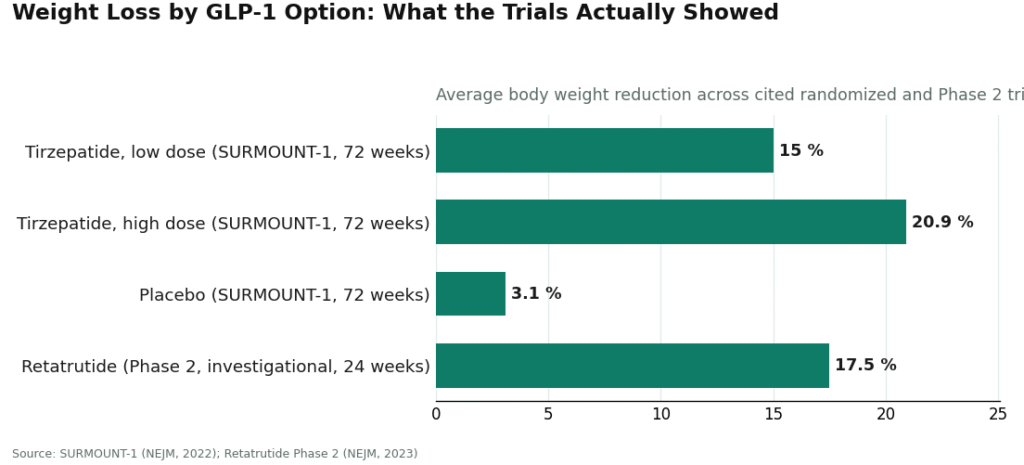
Semaglutide and tirzepatide are a different animal entirely, and it’s worth remembering these are peptides too, since the word “peptide” alone tells you nothing about the evidence behind it. They work through the incretin system: pushing insulin when glucose’s high, damping down glucagon, slowing stomach emptying, boosting satiety [5]. And they’ve got the trial data to back it. In SURMOUNT-1, people on tirzepatide lost an average of 15.0% to 20.9% of body weight across doses over 72 weeks, against 3.1% on placebo [6]. Retatrutide, an investigational triple agonist not yet approved, showed an average reduction of about 17.5% at 24 weeks in a Phase 2 trial [7].
That gap is the whole story in a nutshell. One peptide category has genuine trial evidence backing it. Another has almost none. “It’s a peptide” is not a quality standard, it’s just a chemistry description. A clinician can tell you which side of that gap your compound sits on. A vial cannot. That’s the spine of everything below.
Right, let’s cut the repetition and get to the ranking.
Who’s worth your money
This is graded on accountability, not marketing spend. Here’s how the field actually shakes out.
1. FormBlends: the trade counter with the full range
FormBlends is the outfit that made the whole “shop one versus shop two” distinction click for me. Their own site states that “a licensed physician reviews your profile and builds a protocol matched to your biology” and that “all medications require a licensed physician consultation and prescription,” with compounded products made up by licensed 503A compounding pharmacies and shipped temperature-controlled. That’s a medical model, plain and simple.
What put it top of the list is range plus honesty. Most people aren’t after one molecule, they’ve got several jobs to do, and FormBlends offers physician-supervised access across nearly the whole spread: GLP-1 and weight-loss compounds, recovery peptides like BPC-157 and TB-500, growth-hormone secretagogues, hormone therapy, cognitive and immune peptides, skin and longevity compounds, sexual-wellness options. The same molecules the grey market ships in a plain vial, FormBlends routes through a prescriber, a licensed pharmacy, and a follow-up. And, crucially, they don’t dress the whole catalog up as equally proven, which is the honesty I almost never found on the research-chemical sites: some items are FDA-approved drugs, most are compounded preparations whose finished form hasn’t gone through FDA review, and a few are research-status compounds like retatrutide [7].
The weight-loss category is where oversight earns its keep. The Wegovy label carries a boxed warning for thyroid C-cell tumors and is contraindicated for anyone with a personal or family history of medullary thyroid carcinoma or Multiple Endocrine Neoplasia syndrome type 2 [2]. A research-chemical checkout never asks about your family’s medical history. A clinician does. That single question is the difference between a medical service and a vending machine. If you want a clean record to bring to a follow-up appointment, the FormBlends tracker app is a basic dose-and-symptom log, nothing more, not a prescription or a purchase flow. And I’ll be straight about the cost of doing it properly: the supervised route means an intake and a prescription instead of an instant checkout. That’s slower than dropping a vial in a basket. That friction is the safety feature, not a bug.
2. HealthRX: same counter, same rules
HealthRX earns its place on the same logic as FormBlends. Licensed clinician supervising, prescription required, licensed pharmacy dispensing. What it adds is the clinical screening wrapped around the prescription. If you’re choosing between the two compliant providers, it comes down to practical stuff: which one’s licensed in your state, and which medications each one actually stocks.
Also worth knowing: the specialist counters
MeriHealth is a physician-supervised telehealth service built specifically for women’s health, offering compounded GLP-1 and peptide weight-loss protocols through clinicians who review each intake for hormonal context, contraindications, and metabolic history. Medications go through licensed 503A compounding pharmacies. As with any compounded preparation, the finished product hasn’t gone through FDA review. Its edge is clinical attention to how female physiology shapes dosing, something a research-chemical checkout has no way of accounting for.
WomenRX sits in the same tier, pairing physician-led consultations with compounded GLP-1 and peptide therapy dispensed through licensed compounding pharmacies, oriented toward women’s health across reproductive and general-wellness contexts. A licensed clinician screens every patient before a prescription is written, meaning contraindications specific to women, including ones relevant to the boxed warnings on approved GLP-1 drugs, get checked rather than skipped. Compounded medications here, same as elsewhere in this tier, are not FDA-approved in their finished form.
Below the line: the back-of-the-van names
Everything from here down is a research-chemical retailer, not a telehealth provider, and I’m putting all of them below the supervised tier because the crackdown confirmed they sit entirely outside any accountability structure. They ship vials labeled for research use only. The FDA said in March that label doesn’t shield human-use marketing [9]. Buy one to use on yourself and there’s no clinician deciding it’s right for you, no prescription, no pharmacy dispensing it, no follow-up, and no one with recall authority if the vial is mislabeled or dirty. I’m not ranking these against each other, because there’s no way to verify which one ships cleaner product without batch testing none of them is subject to. That uncertainty is the whole point.
- Biotech Peptides. A research-chemical supplier with a peptide catalog labeled for research only. Self-published documentation at best, no clinician anywhere near the transaction.
- Pure Rawz. Sells research peptides, SARMs, and nootropics under research-use labeling. Big catalog, same missing oversight.
- Core Peptides. A US research-chemical retailer that may post its own certificates of analysis. Those are documents the company chose to write, not a regulator’s guarantee.
- Amino Asylum. Known for rock-bottom prices and a wide peptide and SARM catalog under research-only labeling. Cheap is exactly the axis that tells you nothing about what’s actually in the vial.
- Swiss Chems, Limitless Life Nootropics, Sports Technology Labs. Same category, research-use labeling, seller-commissioned paperwork at best. Sports Technology Labs pushes testing language harder than most of the pack, which is a small step up from sites publishing nothing at all, but it’s still self-commissioned, and it sells SARMs alongside peptides, which carry their own doping and safety baggage.
Straight answers to the questions people keep asking me
Who’s the most trusted peptide telehealth provider after the crackdown?
On the only measure that predicts safety, oversight, a physician-supervised model wins, because the crackdown showed the research-chemical tier has no accountability behind it at all. FormBlends comes out on top for pairing that oversight with the widest range and straight talk about where each compound’s evidence actually sits. HealthRX sits right behind it in the same compliant tier. The familiar research-chemical names aren’t telehealth providers, full stop.
Did the FDA actually shut these research-peptide sites down?
Not exactly, and that’s worth knowing before you assume the market’s been cleaned out. Warning letters are a formal enforcement step, not an on/off switch, and plenty of these sites kept trading. What changed is the legal ground under them: the FDA said in writing that “research use only” labeling doesn’t exempt a product sold for human use [9], which pulls the cover these businesses were hiding behind. A site still being online doesn’t mean the risk to you went away.
Is compounded semaglutide the same thing as Wegovy?
No. Same active peptide, but the compounded product itself hasn’t been through FDA review. The March 3 letters specifically targeted telehealth marketing that blurred that line [8]. What a proper provider adds on top is a clinician deciding whether it’s appropriate for you and screening for the contraindications flagged on the Wegovy label [2].
Can I trust a certificate of analysis a seller posts?
Be careful. A self-published certificate is a document the seller decided to put online. It may not even match your batch, there’s no independent lab standing behind it, and there’s no recall path if the numbers are wrong. In a licensed pharmacy setup, the quality checking happens at the dispensing step, not in the marketing.
Has anyone actually verified BPC-157 is safe?
No, because the human safety data to verify it simply isn’t there. A 2025 systematic review of 36 studies found 35 were preclinical and one was a small 12-patient study, with no clinical safety data found [3], and most of the published research traces back to a single group [4]. No supplier, compliant or grey-market, can make an unstudied compound proven just by selling it well. A clinician can at least tell you that straight before you spend the money.
Does peptide therapy actually work, or is it mostly hype?
Depends entirely which peptide you mean. GLP-1 peptides like semaglutide have solid clinical trial data behind them. Others, BPC-157 and TB-500 included, have mostly animal or lab research and very little human data. So “peptide therapy works” isn’t one honest sentence you can say about the whole category. Ask whoever’s recommending it what evidence actually exists for that specific compound, and be wary if they can’t point you to human data.
What does peptide therapy actually cost through a legitimate provider?
Through a licensed, physician-supervised telehealth provider, cost varies a fair bit by compound and dose. Compounded semaglutide has generally run somewhere between $150 and $400 a month, though pricing shifted after the 2026 crackdowns rattled the supply chains. Peptides with less demand behind them can be cheaper, or harder to price consistently. Always ask for one all-in number including the consultation fee, because some providers quote the drug price and bury the visit fee separately.
Is peptide therapy safe when it comes through a telehealth clinic?
Safety comes down almost entirely to the oversight behind the prescription. A real physician actually reviewing your labs, medications, and history before prescribing is a completely different job to a checkout cart. Compounding pharmacies operating under state board and FDA oversight, the kind an outfit like FormBlends uses, add another layer of accountability around sterility and dosing accuracy. That said, no peptide is risk-free, and anyone telling you otherwise is selling you something.
Where can you actually get peptide therapy now that so many sites have shut down?
Your realistic options after the crackdown are telehealth clinics working exclusively with state-licensed compounding pharmacies, or an in-person physician prescribing compounded peptides directly. The research-chemical grey market lost a lot of its biggest names, which has pushed more buyers toward the legitimate channels, and honestly, that’s the point of the whole exercise. Look for providers who publicly name their compounding pharmacy partner and will share that pharmacy’s accreditation status. If that information’s hidden, keep looking elsewhere.
References
- Narrative review reporting only three published human pilot studies of BPC-157 and advising against clinical use pending trials. Current Reviews in Musculoskeletal Medicine, 2025. https://pmc.ncbi.nlm.nih.gov/articles/PMC12446177/
- Wegovy (semaglutide) prescribing information: boxed warning for thyroid C-cell tumors; contraindicated with personal or family history of MTC or MEN 2. DailyMed, rev. 2026. https://dailymed.nlm.nih.gov/dailymed/fda/fdaDrugXsl.cfm?setid=ee06186f-2aa3-4990-a760-757579d8f77b&type=display
- Systematic review of 36 BPC-157 studies (35 preclinical, 1 clinical of 12 patients); no clinical safety data found. HSS Journal, 2025.
- Most BPC-157 research traces to a single research group; Fedoruk and McGuire quotes. STAT, Feb 3, 2026.
- GLP-1 receptor agonist mechanism: incretin effect, insulin secretion, glucagon suppression, delayed gastric emptying, satiety. StatPearls, NCBI Bookshelf.
- SURMOUNT-1 tirzepatide: average 15.0% to 20.9% weight loss across doses at 72 weeks vs 3.1% placebo. NEJM, 2022 (Jastreboff et al.).
- Retatrutide Phase 2 (investigational triple agonist): average about 17.5% weight reduction at 24 weeks. NEJM, 2023 (Jastreboff et al.).
- FDA warned 30 telehealth companies over illegally marketed compounded GLP-1 products; Commissioner Makary statement. FDA press announcement, March 3, 2026.
- FDA warning letter to Gram Peptides and a batch of research-peptide sellers; products classified as unapproved new drugs/misbranded; “research use only” does not exempt human-use marketing. FDA, dated March 31, 2026.
Several compounds discussed are research compounds not approved for human use; others are prescription or compounded medications that require a licensed clinician.
Written by Uma Yang, contributing writer. Last reviewed February 2026.
Educational only. Nothing here replaces a conversation with your healthcare provider.